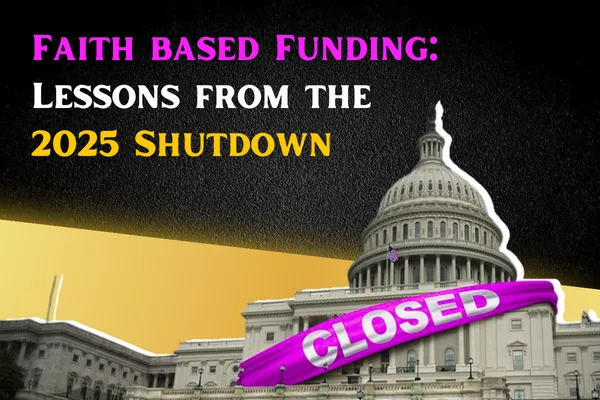
What the Government Shutdown Taught Us About Faith-Based Funding (And Why Your Ministry Needs a Plan B)
The 43-Day Crisis That Proved What Faith Leaders Already Knew
Let me tell you what happened while Washington fought over spending bills.
On November 1, 2025, for the first time in the 60-year history of SNAP (Supplemental Nutrition Assistance Program), the federal government froze funding. 42 million Americans, including 16 million children, suddenly lost access to an average of $187 per month in food assistance.
The government shutdown that began on October 1st stretched into 43 days, becoming the longest in American history. Federal workers missed paychecks. Families emptied their pantries. States scrambled for solutions.
And who showed up first?
Churches. Ministries. Faith-based community organizations.
Not after 48 hours. Not when FEMA arrived. Immediately.
From suburban Detroit to Charlotte to Baltimore, churches opened emergency food pantries, served hot meals, distributed grocery gift cards, and fed families who'd never needed help before. Some food banks saw a 20% spike in traffic within the first week. The Capital Area Food Bank in Washington, D.C., allocated an extra 1 million meals for November alone.
This wasn't charity. This was crisis management.
And it revealed something Washington can no longer ignore: When systems collapse, faith-based organizations don't just fill gaps; they ARE the infrastructure.
The $700 Billion Opportunity Most Ministries Overlook
The federal government allocates over $700 billion a year in grants and contracts, many directly tied to the work faith organizations already do:
Food distribution
Family stabilization
Workforce support
Community development
Emergency relief
The shutdown revealed a truth many ministries don't recognize: You are already doing the work federal agencies fund.
You have:
Community trust
Volunteer power
Facilities that operate as community hubs
A track record of showing up immediately in a crisis
The question isn't whether you're eligible for federal funding.
The question is: Why aren't you already accessing it?
Why having a "Plan B" Isn't Optional Anymore
Let me be clear about something: Faith-based funding should never be your only strategy. The shutdown proved that.
If your ministry's survival depends entirely on one funding stream, whether that's government grants, donor gifts, or love offerings, you're one crisis away from closing your doors.
Strategic sustainability requires multiple revenue streams.
That means:
Federal grants for large-scale community programs
State and local contracts for consistent service delivery
Private foundation funding for innovation and pilot projects
Individual donor support for mission-critical operations
Earned revenue through fee-for-service programs where appropriate
The shutdown taught us that preparedness is prophetic. Joseph didn't wait for the famine to build storehouses. He prepared during the years of abundance.
Your ministry needs the same foresight.
What This Means for 2026 Federal Funding
Here's the opportunity most churches are going to miss:
The 2026 federal budget cycle is opening right now. The faith-based organizations that will win funding in 2026 aren't the ones with the biggest budgets or the fanciest offices.
They're the ones who can prove they were ready when the crisis hit.
To win funding in 2026, ministries must show:
Emergency response capacity: Did you mobilize quickly during the shutdown?
Community partnerships: Did you coordinate with food banks, other churches, and local officials?
Outcome tracking: Do you know how many meals you served and how many families you helped?
Compliance systems: Can your account for every dollar and demonstrate stewardship
If you can't answer "yes" to those questions, you're not granted ready yet. But you can be.
The Three Things Every Ministry Must Do Before January 1, 2026
1. Build the Structure Behind Your Calling
Before federal funding ever hits your bank account, agencies want to see one thing: that your ministry can move with clarity, order, and authority when the pressure hits.
That means putting structure behind the heart of your ministry:
Who makes decisions when the need spikes overnight?
How does your team communicate when the phones start ringing?
Do your volunteers know their roles, or do you figure it out as you go?
Can you scale your response without chaos or confusion?
The shutdown didn’t just reveal which ministries cared for.
It revealed which ministries could lead.
Federal agencies partner with organizations that demonstrate their ability to remain stable when systems around them fail.
2. Document Your Crisis Response
If your church or ministry responded during the shutdown, serving meals, distributing food, supporting furloughed workers, document it now.
Create a one-page case study that includes:
Number of people served
Number of meals/food boxes distributed
Dollar value of assistance provided
Partnerships activated
Volunteer hours contributed
This isn't bragging. This is proof of capacity. And it's exactly what federal grant reviewers want to see.
3. Build Your Compliance Foundation
Federal funding requires stewardship, not just service. Before you apply for a single grant, make sure you have:
Current bylaws and articles of incorporation
Active EIN (Employer Identification Number)
Up-to-date financial records
Clear policies around financial management and conflict of interest
Proof of good standing with your state
Compliance isn't red tape. It's the foundation of trustworthiness. And trust unlocks funding.
Your Next Steps: Turn Preparedness into Funding
If you're a pastor, ministry leader, or nonprofit executive who wants to position your organization for 2026 federal funding opportunities, your roadmap starts here:
The Faith & Funding Academy Masterclass is specifically designed to help faith-based leaders:
Register correctly in federal systems (SAM.gov, Grants.gov, UEI)
Build compliance documentation that passes audits
Develop compelling proposals that win funding
Create multiple revenue streams for sustainability
Manage grants responsibly once awarded
All while staying true to your spiritual mission.
Because of the work you're already doing? That qualifies.
The impact you're already making? That's fundable.
The preparedness you demonstrated during the shutdown? That's your competitive advantage.
Ready to become grant-ready?
Join the Faith & Funding Academy. Get live training, templates, and expert guidance to position your ministry for federal funding success in 2026.
Your ministry’s next level starts here.